Apache CloudStack
FIPS-Compliant IaaS

Run Apache CloudStack with end-to-end, FIPS 140-validated cryptography.

FIPS-Compliant CloudStack Version

Build a secure and compliant IaaS environment for reguilated environments and management of sensitive data with Apache CloudStack to meet federal government standards. The FIPS-compliant CloudStack version replaces non-approved algorithms and libraries with FIPS-approved algorithms and libraries, so that the software uses encryption and security methods that meet FIPS standards. 

Built and Maintained for the ShapeBlue’s Customers

The FIPS-validated version of Apache CloudStack is a ShapeBlue’s maintained distribution of Apache CloudStack that enforces only NIST CMVP-validated cryptographic modules and algorithms across the stack. TLS, SSH, key management, and internal services adhere to FIPS 140-2/140-3 requirements – ideal for government, defense, finance, healthcare, and critical infrastructure.

This version of Apache CloudStack is available exclusively to ShapeBlue customers because it requires ongoing specialized maintenance, security updates, and compliance monitoring to ensure continuous adherence to FIPS standards. ShapeBlue provides high level of support and assurance necessary for organizations with strict regulatory or contractual obligations. This approach ensures that the platform remains secure, compliant, and fully supported in sensitive and highly regulated environments.

CloudStack Security Implementation Summary

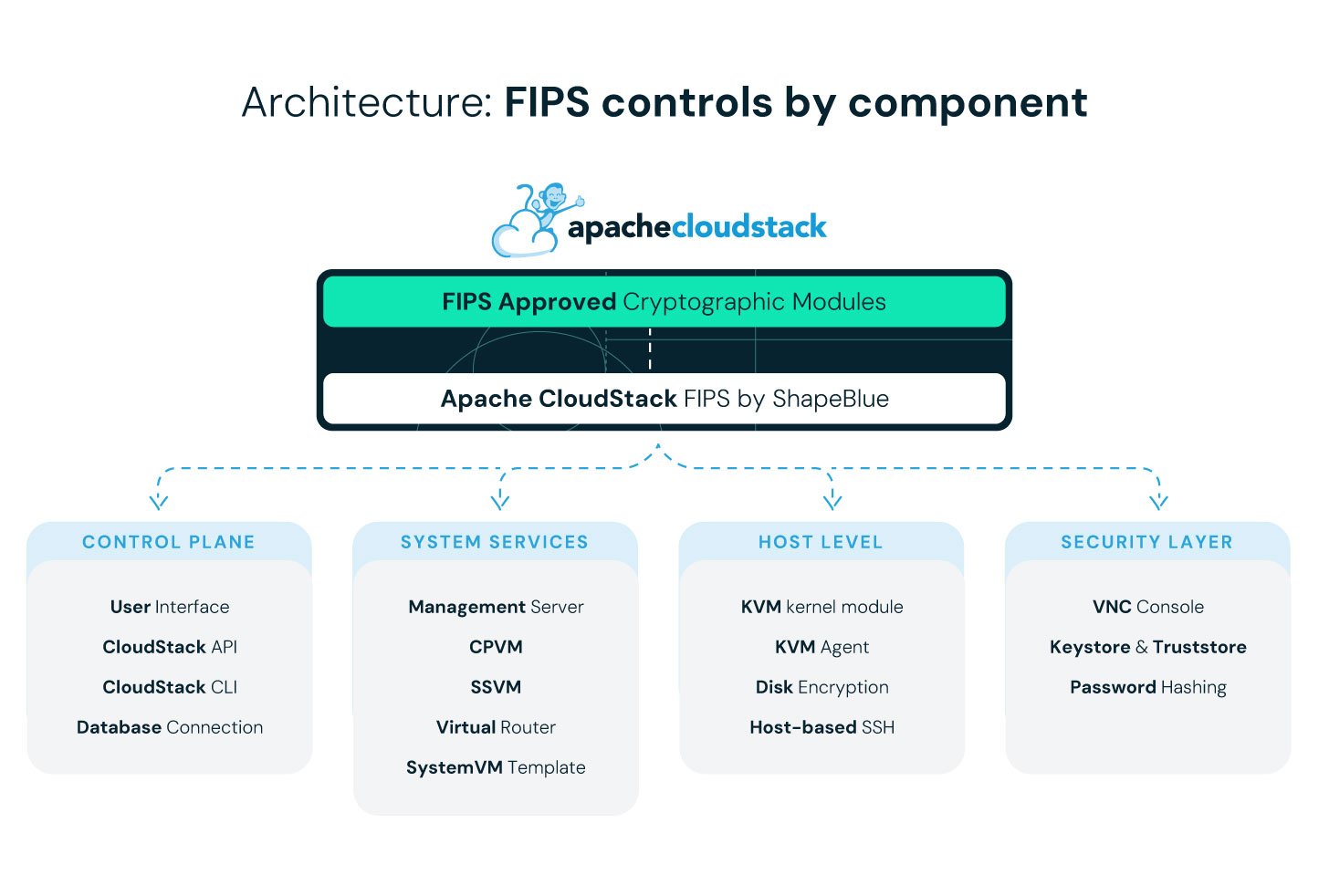
Control Plane

System Services

Host Level

Security Layer

Component

Security implementation

UI / API / CLI

Database Connection

Enforces TLS 1.2/1.3 with CMVP-validated cipher suites
Encrypted JDBC connection using CMVP-validated crypto providers

Management Server

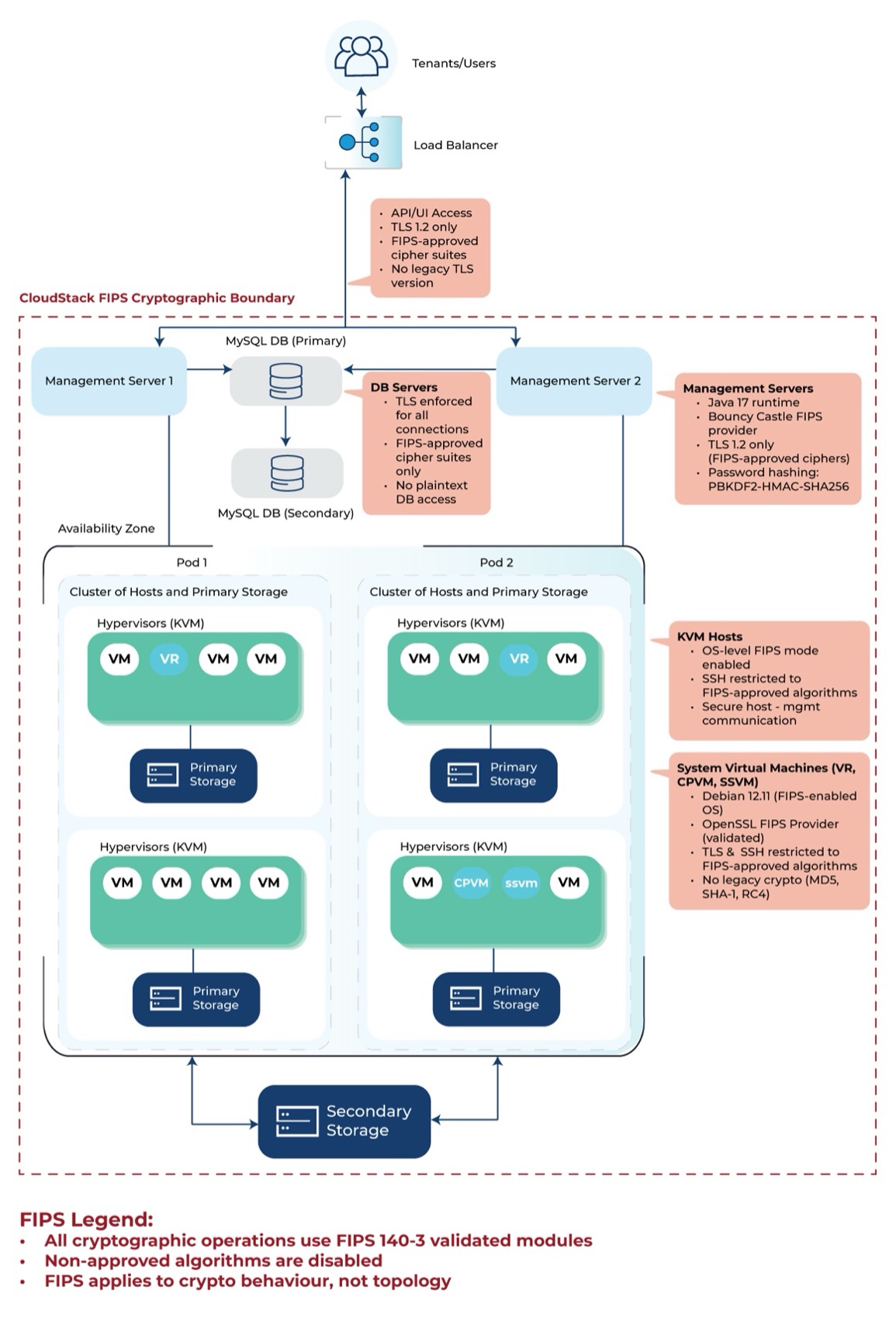
CPVM / SSVM / VR

SystemVM Templates

Built with BCFIPS; all crypto operations routed via FIPS 140-approved modules; hardened TLS and keystore config

SystemVMs boot with kernel FIPS mode, OpenSSL in FIPS mode; hardened services (SSH, HAProxy)

Delivered with validated cryptographic settings and hardened base images

KVM Kernel Module

KVM Agent

Instance Volume Encryption

Host-based SSH

FIPS kernel mode enabled at boot

Communicates with Management Server via TLS 1.2/1.3 using CMVP-validated cryptographic providers

AES-256 via LUKS using FIPS-validated module

Restricted to FIPS-approved ciphers, MACs, and host key types

VNC Console Proxy

Keystore & Truststore

Password Hashing

TLS 1.2/1.3 enforced; keystore with BCFIPS-backed truststore

Encrypted stores using CMVP-validated libraries

FIPS-compliant hash algorithms (e.g., PBKDF2, SHA-2 family)

Component / Security Implementation

Control Plane

UI / API / CLI

Enforces TLS 1.2/1.3 with CMVP-validated cipher suites

Database Connection

Encrypted JDBC connection using CMVP-validated crypto providers

System Services

Management Server

Built with BCFIPS; all crypto operations routed via FIPS 140-approved modules; hardened TLS and keystore config

CPVM / SSVM / VR

SystemVMs boot with kernel FIPS mode, OpenSSL in FIPS mode; hardened services (SSH, HAProxy)

SystemVM Templates

Delivered with validated cryptographic settings and hardened base images

Host Level

KVM Kernel Module

FIPS kernel mode enabled at boot

KVM Agent

Communicates with Management Server via TLS 1.2/1.3 using CMVP-validated cryptographic providers

Instance Volume Encryption

AES-256 via LUKS using FIPS-validated module

Host-based SSH

Restricted to FIPS-approved ciphers, MACs, and host key types

Security Layer

VNC Console Proxy

TLS 1.2/1.3 enforced; keystore with BCFIPS-backed truststore

Keystore & Truststore

Encrypted stores using CMVP-validated libraries

Password Hashing

FIPS-compliant hash algorithms (e.g., PBKDF2, SHA-2 family)

Covered Cryptographic Standards

Algorithm / Technique FIPS 140-2 FIPS 140-3 Comments
AES (GCM, CTR, CBC) Approved Approved Prefer GCM/CTR in practice.
RSA (≥ 2048-bit) Approved Approved PKCS#1 v1.5 acceptable; OAEP recommended where applicable.
ECDHE (P-256/384/521) Approved Approved PFS with NIST curves.
DHE (≥ 2048-bit) Approved Approved Minimum modulus size enforced.
SHA-2 (256/384/512) Approved Approved SHA-1/MD5 not permitted for secure functions.
HMAC-SHA-2 Approved Approved Approved MACs.
TLSv1.2 Approved Approved Minimum version.
SSH (AES-CTR) Approved Approved No RC4/3DES in FIPS mode.
SSH MACs (HMAC-SHA-2) Approved Approved SHA-2 only.
SSH Keys (ECDSA NIST, RSA-SHA-2) Approved Approved DSA disallowed.

Why Choose CloudStack FIPS?

Validated crypto (CMVP)

Exclusive use of FIPS 140-approved modules and algorithms across control and data paths.

Strict TLS/SSH policies

TLS 1.2/1.3 only; SSH limited to FIPS-approved ciphers/MACs and key types.

Hardened SystemVMs

Console Proxy, Secondary Storage, and Virtual Router run with kernel FIPS mode and OpenSSL in FIPS mode.

Delivered and supported by ShapeBlue

CloudStack engineering leaders with deployment automation, validation, and continuous updates.

FIPS 140 certifies cryptographic modules, not complete products. CloudStack FIPS uses CMVP-validated modules and enforces their use platform-wide.

CloudStack FIPS-compliant Version FAQ

What is FIPS?

FIPS stands for Federal Information Processing Standards.

These are public standards developed by the United States federal government, specifically by the National Institute of Standards and Technology (NIST), to ensure that all federal agencies and contractors use consistent, secure, and interoperable information systems.

They are primarily used to ensure security, interoperability, and consistency in IT systems — especially for cryptographic modules, data processing, and system categorization.

FIPS 140 stands for Federal Information Processing Standard 140 – “Security Requirements for Cryptographic Modules”. It defines how cryptographic hardware and software must be designed and implemented to be secure enough for U.S. government use.

In the case of software modules, these are typically libraries or components that perform cryptographic operations like encryption, decryption, hashing, key generation, or secure communications.

The Current version of FIPS 140 standard is FIPS 140-3, which is published on March 22, 2019. You can find more details at https://csrc.nist.gov/pubs/fips/140-3/final

No. FIPS 140 certifies crypto modules. CloudStack FIPS uses CMVP-validated modules and enforces their exclusive use.

Yes, when the underlying module supports it (FIPS 140-3). TLS 1.2 remains the baseline per SP 800-52r2.

Current scope targets KVM (Oracle 8 and 9) (Ubuntu Pro) (RHel 8 and 9) with hardened SystemVMs. Contact us for roadmap/scope extensions.

ShapeBlue packages and runbooks ensure updates preserve FIPS mode and conformance.

No. FIPS addresses crypto modules. Certifications require whole-system controls and audits. CloudStack FIPS accelerates the crypto portion

CloudStack FIPS currently targets KVM on the following Linux distributions:

  • Red Hat Enterprise Linux (RHEL) 8 and 9 (x86_64)
  • Oracle Linux 8 and 9 (x86_64)
  • Ubuntu Pro (LTS) with FIPS packages enabled (x86_64)

FIPS require the OS to boot with FIPS mode enabled and to use CMVP-validated OpenSSL packages. Ubuntu requires Ubuntu Pro to enable the FIPS-certified package set.

The Management Server and KVM Hosts are supported on the same distributions. SystemVMs are delivered hardened for FIPS; no separate OS selection is required for them.

ShapeBlue

Watch back this webinar to learn how to design high-performance infrastructure powered by open-source technology and GPUs.